Not sure which path fits? Take the K9 Stress Bubble Audit — or book a free Meet & Greet.

Free Meet & Greet
Coaching Canine Companions Logo COACHING
CANINE
COMPANIONS
Dog Training for Sensitive, Anxious, and Reactive Dogs
North Kingstown, Rhode Island

Dog Day Training for Sensitive, Anxious & Reactive Dogs

Not daycare. Not a playdate. A structured training day where Lorrie works directly with your dog’s nervous system, leash skills, confidence, recovery, and ability to stay connected under real-life pressure.

5-hour training window Limited dogs per day Pickup handover included Puppies through behavior cases
Book a Free Meet & Greet Take the Stress Bubble Audit
See if this is the right fit

Your Dog Does Not Need Another Day of Being Worn Out

Many dogs come home from daycare exhausted — and still reactive, still frantic on leash, still unable to recover when the world becomes too much. That is because fatigue can hide dysregulation. It does not resolve it.

The Difference: Field-Based Day Training teaches the system underneath the behavior: how your dog processes pressure, returns to connection, responds to guidance, recovers after stress, and makes better choices when the environment gets interesting.

  • 🚫 No Babysitting Disguised as Training: Your dog is not simply watched, walked, or entertained. They are actively coached through real moments of choice, recovery, leash clarity, and relationship.
  • 🚫 No Generic Group Chaos: Social exposure, movement, and play are used carefully as training tools — not as uncontrolled stimulation that sends your dog home more activated than when they arrived.
The Real Difference

The Work Begins
Underneath Obedience

Commands matter. Manners matter. But if your dog cannot think, recover, or stay connected when pressure rises, obedience alone will not hold.

That is where this work is different. Lorrie trains the dog in front of her — not the idea of the dog, not a one-size-fits-all protocol, and not a checklist of commands detached from emotional state.

Each training day blends relationship-centered handling, real-world field exposure, nervous-system regulation, leash clarity, and practical transfer back to you.

Lorrie J. Harris

What Your Dog Learns Here

  • How to stay reachable. Your dog practices staying connected before escalation takes over.
  • How to recover faster. The goal is not a dog who never feels stress; it is a dog who can come back from it.
  • How to follow guidance under pressure. Movement, space, timing, and leash clarity become part of the learning.
  • How to bring the work home. Pickup handovers help you continue the same pattern in your real life.
The 5-Hour Field Session

You Drop Off. Lorrie Trains. Then the Work Comes Home.

01

The Drop-Off

You drop your dog off for a carefully structured training day. Lorrie reads the dog in front of her, sets the day’s pressure level, and builds the work around regulation, movement, leash clarity, confidence, and your goals.

02

The Handover

At pickup, you receive a direct handover: what your dog showed, what changed, what to practice, and how to avoid accidentally undoing the progress between sessions.

03

The Deepening

Your online academy and coaching support keep the work consistent between training days, so progress is not trapped at Lorrie’s property — it begins to show up on your walks, in your home, and in your daily rhythm.

Important Distinction

This is not daycare with a nicer name.

Daycare can supervise a dog, entertain a dog, and tire a dog out. But tired is not the same as trained. Tired is not the same as regulated. And tired is not the same as resilient.

Field-Based Day Training is structured work: nervous-system settling, leash clarity, movement patterns, social decision-making, recovery, confidence, and handler transfer.

What your dog is actually practicing

  • How to recover after pressure, not just avoid pressure.
  • How to follow movement and space cues before verbal commands are needed.
  • How to experience social exposure without being flooded by it.
  • How to bring the training back to you, so progress transfers home.
✦ Boutique Status: 5 New Clients Per Month ✦
Choose the Level of Support

Two Day Training Paths — One Nervous-System-First Method

Most families begin with a free Meet & Greet so Lorrie can help you choose the right level of structure — not the biggest package, the right package.

Essential Harmony

Best for puppies, adolescent dogs, adult dogs, and families who need stronger foundations without a full behavior rebuild.

$1,360
  • 4 full day training sessions
  • Two 1-hour virtual coaching calls
  • Foundational manners, leash clarity, confidence, and regulation
  • 6 months of email access to Lorrie
  • Lifetime access to the Online Academy
Request a Meet & Greet
"This is the part most trainers miss..."
The Nervous-System Edge

Why Regulation Comes Before Reliability

A dog in survival mode cannot reliably access the same brain that learns, chooses, and cooperates.

K9 Bioenergy Balancing is used as a secondary somatic support layer — not as a replacement for training. Think of it as structured decompression before the teaching begins: helping the body settle enough for leash work, social exposure, confidence-building, and handler guidance to become available.

What does this mean in practice? +

Lorrie uses gentle, targeted touch points along the dog's body to help the autonomic nervous system shift out of sympathetic dominance (fight/flight) and into a state where learning, connection, and cooperation become neurologically available. For skeptics: think of it as a structured decompression protocol — the outcome is measurable in the dog's subsequent capacity to engage. It is always paired with evidence-based behavioural work, never used in isolation.

What Changes When the Body Can Learn

  • Nervous System First. Regulation before commands.
  • Field Dialogue. Communicating through movement, space, rhythm, and relationship.
  • Social Momentum. Using carefully chosen dog-dog exposure when it supports confidence, not chaos.
Your Dog’s Trainer

Meet Lorrie Harris

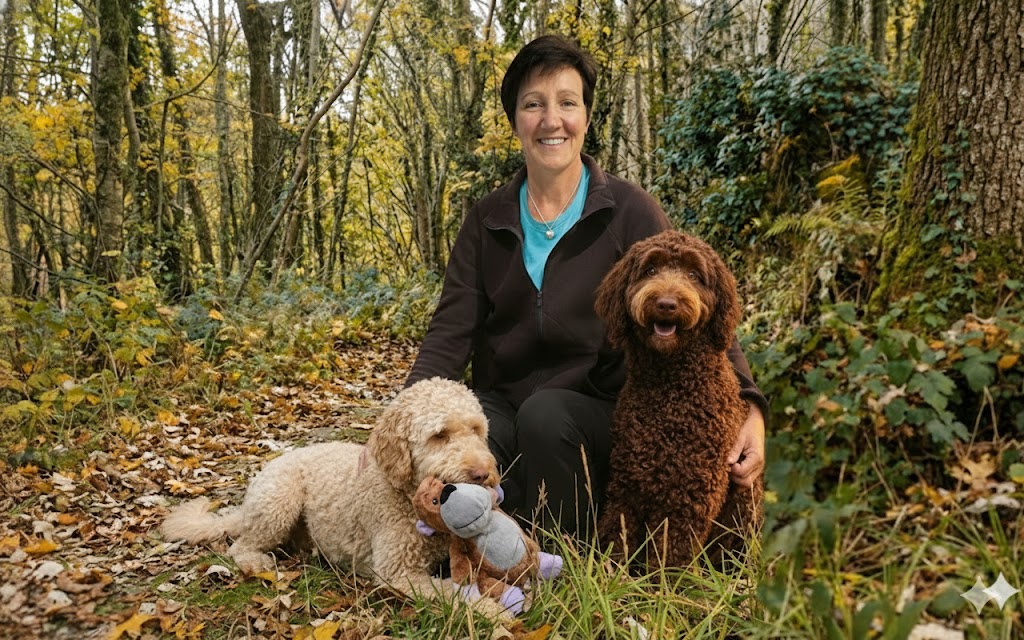
Lorrie Harris is the founder of Coaching Canine Companions and the trainer working directly with your dog. Her work is especially suited for sensitive, anxious, reactive, intense, and easily overwhelmed dogs whose behavior does not improve through commands alone.

Her background includes professional dog training, behavior work, health coaching, and years of observing how dogs organize around human state, movement, pressure, and relationship. The result is a training process that is practical, deeply individualized, and built for real-life transfer.

Lorrie J. Harris

Professional Accreditations

Master Dog Training Certification (National K-9)
Former Bomb Detection Dog Specialist (IPWDA)
Member, Int. Association of Canine Professionals
Registered AKC Canine Good Citizen Assessor
The Larger Path

Day Training may be the right answer — or the doorway to the deeper work.

For some dogs, a focused day training series is enough to open the door: better walks, better recovery, clearer communication, and a calmer home rhythm.

For others, day training reveals that the pattern is more layered. That is where the 90-Day Field-Based Regulation Training program comes in — with assessment, CRI tracking, field tests, and a documented Transformation Report.

How Lorrie helps you choose

We do not guess from the outside. We look at recovery time, pattern repetition, handler transfer, environmental load, leash response, and your dog’s ability to return to connection after stress.

That is the difference between buying training sessions and entering a system.

Explore the 90-Day Program
Field Questions

What People Ask When the Bark Has Already Happened

If you have been searching for a calmer, more honest way forward with your dog, begin here.

"Why does my dog suddenly bark or lunge out of nowhere?"
+

It doesn't come out of nowhere.

It comes from a place you were never taught to look.

The bark is not the beginning. It is the release.

Before it, there was a breath that changed… a body that tightened… a world that narrowed.

By the time you hear it — the nervous system has already decided.

What you are seeing is not unpredictability. You are seeing the final moment of a process that began quietly… three steps ago.

"How do I stop my dog from reacting on walks?"
+

You don't stop the reaction. You learn to meet the moment before it becomes one.

Most people try to control the explosion. But the work lives in something far less dramatic:

Three steps. Stop.
Three steps. Stop.

You are not fixing behavior. You are changing the rhythm that behavior depends on.

And when the rhythm changes — the reaction often never needs to happen.

"Is my dog being stubborn or ignoring me?"
+

No.

Your dog is leaving you. Not emotionally. Biologically.

When the nervous system enters survival, the part of the brain that listens… disappears.

This is not defiance. This is disconnection.

And you cannot call a dog back from a place they no longer have access to. You must meet them where they went.

"Should I correct my dog when they react?"
+

If you correct a body in survival — you confirm the danger.

You may suppress the behavior. But you strengthen the state that created it.

And that state will return. Often louder. Often faster.

The question is not: "How do I stop this?"

The question is: "What state is my dog in right now?"

Because behavior follows state. Always.

"Why does my dog seem fine one minute and reactive the next?"
+

Because you are measuring the wrong moment. You are measuring the visible moment. But the shift happened earlier.

A scent you didn't detect. A sound you didn't register. A memory that returned without warning.

Your dog lives in a world of signals. You live in a world of outcomes.

This work is the bridge between the two.

"How do I calm my dog down quickly?"
+

You don't calm the nervous system with urgency. You slow it. You give it space to remember where it is.

Sometimes that looks like stillness. Sometimes that looks like distance. Sometimes it looks like doing almost nothing at all.

And in that "nothing" — the body begins to reorganize itself.

You may see it: A shake. A yawn. A sudden interest in the ground.

These are not random. They are the body releasing what it no longer needs.

"How long will it take for my dog to improve?"
+

That depends on what you are measuring.

If you are measuring obedience — you may always feel behind.

If you are measuring regulation — you will begin to see change immediately. Not in perfection. But in moments:

  • The reaction that almost happened… but didn't
  • The breath that returned a little sooner
  • The space between trigger and response widening

This is how change actually occurs. Quietly. Before anyone else can see it.

"What should I do in the moment when my dog is already reacting?"
+

First — remove the expectation that learning is happening. Because it isn't.

Then: Create space. Reduce pressure. Say less than you want to say.

And wait. Not passively — but attentively.

You are waiting for the moment the body softens. Because that moment — is your way back in.

"Can my dog ever fully get over this?"
+

Your dog is not broken. Your dog is responsive. To the world. To the environment. To you.

And here is the quiet truth: as your ability to see earlier deepens… your dog's need to escalate often fades.

Not because they were "fixed." But because they were finally understood.

Closing Reflection

Most people search for better techniques. Better tools. Better timing. Better control.

But the shift does not begin there. It begins in a place far less visible — and far more powerful.

The moment before the bark.

Not sure where to begin? Take the 3-Minute Stress Bubble Audit.

3-Minute Assessment

The K9 Stress Bubble Audit

Some days your dog feels reachable. Other days it's like they disappear right in front of you. Let me ask you something most trainers never will.

Question 1 of 6
What Our Clients Say

Real Dogs. Real Results.

Google Reviews
★★★★★
5.0
★★★★★

"When we started with Lorrie, we couldn't walk our dogs on leash — they pulled so much! Now they are a treat to walk. Their recall is better, anxiety is lower, and our bond is stronger. We have loved working with Lorrie. 100% worth it."

S
Stef C.
30 weeks ago · Google
★★★★★

"Lorrie is such an incredible trainer with so much great experience! She has a different approach to training that is all about calming the nervous system and involving play. She helped me connect with my rescue pup on a deeper level. Lorrie is now Auntie Lorrie as my dog LOVES going for his sessions."

S
Samantha P.
44 weeks ago · Google
★★★★★

"Lorrie is an incredible, compassionate trainer. She connects with the dog at a level I did not even know existed. By God's grace I found Lorrie. Her instruction was explicit and spot on — the results were immediate! My pup and I have a bond now that is strong and will continue to grow."

J
Julie M.
May 2024 · Google
★★★★★

"Lorrie is positively outstanding as a master dog trainer! Her expertise in teaching dogs to self-regulate and become responsive instead of reactive is the most unique and impactful part of her practice. Our dog is TRANSFORMED and it is due entirely to making the decision to work with Lorrie at CCC!!"

K
Kylan Turner
March 2023 · Google
★★★★★

"After the first day of training my 4 year old Australian Shepherd walked with a loose leash after years of pulling. Her training is methodical, results oriented, and aligns with the dog owner's goals. My dog clearly looked forward to seeing her. Highly recommend."

A
Alexandra Gillis
October 2024 · Google
See It In Practice

Watch the Method in Motion

Nervous-System-First Dog Training in Practice

Unlocking the Secrets of Balanced Dog Training

The Joy-Driven Dog — Building Behavior Through Play

From the Field Library

Related Reading

Next Step

Let’s Find the Right Training Path for Your Dog

❌ “Which package should I buy?”

✅ “What does my dog’s nervous system actually need next?”

Book a Free Meet & Greet

Enrollment is intentionally limited so each dog receives careful, individualized field work. A deposit is required only after your training reservation is approved.